Table Of Content
- Warehouse Layout Planning Tips
- Warehouse Operations
- Expert Warehouse Design and Layout Ideas and Tips
- How to Design aWarehouse Layout Plan: Tips & Examples From Real Companies
- Plan for Growth and Adaptability
- key things to consider when designing a warehouse layout
- Efficient Warehouse Design: A Step-by-Step Optimization Guide

A large part of your warehouse efficiency comes back to how your warehouse is set up, so it’s crucial to design your warehouse appropriately so you’re set up for success. As a leading logistics and fulfillment provider, ShipBob has experience designing and setting up warehouses. When workers are clear on their expectations and how they might thrive in their positions, they are happier.
Warehouse Layout Planning Tips
The technologies seamlessly integrate into existing workflows, providing flexibility in responding to changing order volumes and operational dynamics. This adaptability ensures that the order picking process remains agile and responsive to evolving business needs. In the dynamic landscape of warehouse operations, the heartbeat of efficiency is often found in the realm of order picking. Enhanced Picking Technologies, including Pick to Light, Collaborative Mobile Robots (CMRs), drones, and Automated Guided Vehicles (AGVs), emerge as the virtuosos of order fulfillment.
What is the impact of AI and ML on Warehouse Management and order fulfillment in Supply Chain Management? - ResearchGate
What is the impact of AI and ML on Warehouse Management and order fulfillment in Supply Chain Management?.
Posted: Tue, 18 Jul 2023 07:00:00 GMT [source]
Warehouse Operations
The U shape is utilised to divide and simplify the main traffic flow in warehouses. To prevent bottlenecks, keep the entering and departing materials on opposite sides of the operation. In addition, because the entry and exit are on the same side of the structure, fewer packages must be stored there, and staff may transport goods between receiving and shipping.
Expert Warehouse Design and Layout Ideas and Tips
Actively solicit feedback from warehouse staff, operators, and other frontline personnel to gather qualitative insights into the efficiency and functionality of the existing layout. Empower the workforce with training programs focused on adaptive operations within a flexible warehouse environment. Training should emphasize the utilization of modular workstations, understanding changes in workflow, and adapting seamlessly to technological enhancements. Equip personnel with the knowledge and skills required to operate warehouse equipment safely. This includes forklift operation, understanding automated systems, and adherence to safety protocols during equipment interaction.
Being as structured as possible is essential to keeping your warehouse layout operating smoothly. Labels can be used in various ways to guarantee that every item entering the warehouse is put exactly where it needs to be. In addition, employees in the warehouse who need to get ready for incoming customer orders might also benefit from labelling. One aspect that impacts whether a consumer would return is whether you provide outstanding services—timely delivery.

Plan for Growth and Adaptability
This entails a delicate balance between maximizing storage space through narrow aisles and ensuring efficient material handling with wider aisles. In conclusion, the creation of strategic storage zones is a fundamental aspect of warehouse layout design. By grouping similar products based on demand patterns and storage compatibility, you not only minimize travel time but also enhance overall operational efficiency. This step is pivotal in creating a warehouse layout that is responsive to the dynamic needs of the business. While planning your warehouse layout, it is crucial to ensure easy accessibility to all the areas and products in your facility. The layout should be designed in a way that makes it easy for personnel to navigate throughout the facility while conveniently locating and picking items without having to move other products.
3 New Warehouses totaling 2.5 Million Square Feet Approved in Apple Valley - Victor Valley News - VVNG
3 New Warehouses totaling 2.5 Million Square Feet Approved in Apple Valley.
Posted: Thu, 16 Nov 2023 08:00:00 GMT [source]
The key factor to keeping your warehouse layout flowing effectively is to be as organized as possible. Labels can be used in different ways to ensure every item that enters the warehouse is placed exactly where it needs to be. Labeling is also useful for warehouse employees who need to prepare for incoming customer orders. The disadvantages of the I shape are that companies need to have optimal loading and unloading space on two sides of the warehouse building. Costs may increase when purchasing docking equipment for the inbound and outbound areas and goods often need to travel the entire length of the warehouse to reach their intended destination.
Utilize labor and budgets effectively
If you want to learn more about warehouse digitalization and optimizing warehouse processes, you can follow us on LinkedIn, YouTube, X, or Facebook. If you have other inquiries or suggestions, don’t hesitate to contact us here. Although every warehouse owner and manager has unique needs for their layout, they often use the same starting point. Many warehouses are variations of one of four common layouts and are selected based on each one’s pros and cons.
Efficient Warehouse Design: A Step-by-Step Optimization Guide
Make sure to consider the opinions and concerns of warehouse staff and other employees who actively participate in the workflow. If you hope to keep the shipping and receiving areas close, the U-shaped warehouse flow may fulfill that. If you prefer to keep an in-and-out workflow while minimizing space usage, you may prefer the I-shaped warehouse flow. Once you know all the pieces that need to come together in your warehouse, you can start making moves towards actually designing your ideal warehouse layout. Your warehouse layout design should include all the necessary areas that your facility requires, while utilizing every inch of usable space. All components are arranged in a semicircle with shipping and receiving on parallel sides and storage in the middle.
A well designed layout will help to avoid being one of the 160k truck accidents that occur every year and avoid costly delays. This symphony is more than a technological marvel; it is a testament to the evolution of warehouse operations. By embracing advanced automation solutions, warehouses transcend traditional constraints, ushering in an era where efficiency, spatial optimization, and operational excellence converge.
Embrace an iterative testing and refinement process for layout modifications. Implement changes on a small scale, monitor their impact, gather feedback, and refine further. This iterative approach minimizes the risk of large-scale disruptions while continuously enhancing layout effectiveness. Explore the realm of predictive analytics to anticipate future challenges and opportunities.
Warehouse layouts are an excellent choice for all types of warehouses regardless of their shape, size, and flow. It is a foolproof plan to organize the loading and unloading area, reception area, storage space, picking, and dispatch area. It is essential to design a functional warehouse layout since it directly affects the effectiveness and productivity of your warehouse.
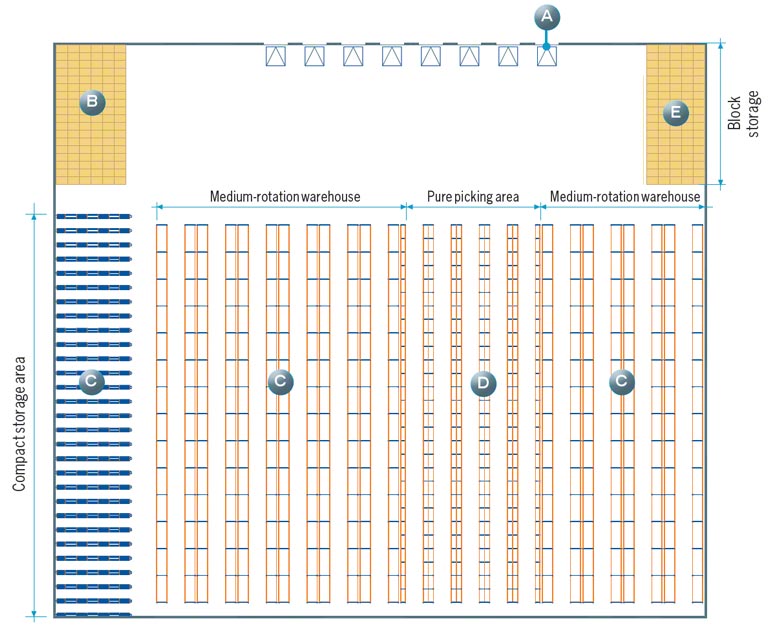
Good planning is necessary to develop the infrastructure, secure the warehouse(s), and purchase the equipment you’ll need. To optimize storage and warehouse processes, be sure to learn how warehouse slotting works, so you can organize your warehouse around functionality and efficiency. You and your team is responsible for loading trucks and making sure that all orders are picked, packed, and shipped accurately when they leave the warehouse. Be sure to accommodate room in your warehouse for a large volume of orders being loaded simultaneously. The ability to track inventory in real time is an important part of the ecommerce supply chain and critical for ecommerce brands that want to scale. As you begin building a proper warehouse layout, you will want to focus on functionality and efficiency.
When building your strategy, assess all these factors and analyze your space to understand what will work best for your warehouse and needs. Because it’s simple to create and adjust warehouse floor plans, owners and managers can also optimize equipment installations using their digital twin. Eliminating equipment clashes and change orders from inaccurate site plans saves serious time and money. Planning Mechanical, Electrical and Plumbing (MEP) work to accommodate new equipment is more accurate when using the true-to-life digital replica to scope the changes. Once you’ve picked a design that suits your building and desired warehouse flow, create a floor plan that documents your new layout.
Providing your employees with ergonomically designed tools can help reduce physical strain and injury while also improving their overall productivity. Having an effective warehouse flow also helps ensure that orders are fulfilled quickly and accurately, which is essential for any successful business. These systems can help to streamline processes in your warehouse, freeing up time for you and your employees. These technologies can help to reduce manual labor for tasks like sorting, picking, packing, and shipping — allowing your employees to focus on more value-added activities. If most of your items are small or abnormally shaped, then you’ll need to consider alternatives. These may include floor-level shelving, mezzanine floors, or even vertical carousels.